
What NATO's Counter-Drone Marketplace Means for the Western Balkans

NATO’s own words announcing Drone Edge in July 2026 say the $40 billion program exists “to support rapid procurement,” so that counter-drone systems are “NATO-tested, NATO-compatible, and available for purchase.” NATO didn’t call it a marketplace to save money or to build another owned fleet. It called it a marketplace to buy fast. That is worth pausing on, because everything else NATO pools — three C-17 transport aircraft, a shared Airbus A400M fleet — is priced the old way: an accession fee, a flight-hour quota, a stake in an asset built to last thirty years. Counter-drone technology isn’t built to last thirty years, and NATO’s own procurement choice, even without saying so directly, treats it that way. Albania, Montenegro and North Macedonia are still framing their own procurement decisions as pooling versus leasing. The more useful question, and the one NATO’s own structure already answers for itself, is which of a state’s own capabilities are worth owning a stake in for the long run, and which need to be bought the way Drone Edge is bought — fast, and without a long-term claim attached.
What the budgets can buy
NATO’s own Defence Investment of NATO Countries (2014-2026) report gives the baseline. All three states are spending more, just not enough. Albania goes from $450 million to $722 million between 2025 and 2026, lifting its GDP share from 1.48% to 2.15%. Montenegro’s budget grows more modestly, from $188 million to $222 million, its share up from 2.04% to 2.17%. North Macedonia’s dollar figure also rises, from $402 million to $452 million, but its GDP share barely moves, 2.10% to 2.09%. Though they all clear the old 2%-of-GDP guideline, none is within reach of the 3.5% core-defence target NATO set at the 2025 Hague Summit.
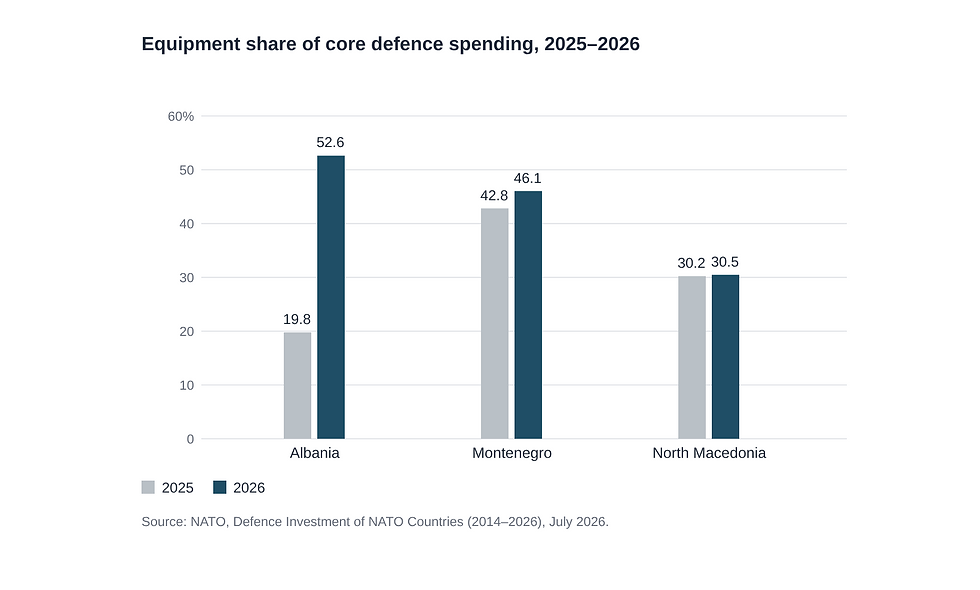
Equipment spending is the more telling number, because it funds new capability rather than salaries. In Albania it more than doubled, from 19.77% of core spending in 2025 to 52.62% in 2026, evidence of one large program landing in a single budget year. Montenegro’s climbed too, from 42.83% to 46.05%. North Macedonia’s held almost flat, 30.22% to 30.48%, and personnel still eat 41.72% of its budget. The gap shows in what these budgets can actually buy. A single $15 million counter-drone system, one mid-tier acquisition, would consume 10.9% of North Macedonia’s annual equipment budget and 14.7% of Montenegro’s.
Pooling, leasing and ownership
Romania buys 200 flight hours a year through NATO’s Strategic Airlift Capability, making it the fifth-largest contributor to the programme. The programme is jointly owned by twelve countries and operates three Boeing C-17 transport aircraft based at Pápa Air Base in Hungary. That is what pooling means looks like: countries pay an upfront fee linked to the fleet’s value, then contribute annually according to their share of flight hours or capacity. Bulgaria holds 65 hours and embeds three personnel in the operating wing. Slovenia holds 60. Croatia joined a newer version of the same model in 2026, one of seven launch partners in a pooled Airbus A400M fleet. Intellectual property follows fixed rules across these programmes. Manufacturers retain what they build, while jointly developed assets belong to the pool. Countries retain control of their own mission data even when they share the hardware.
One class of vendor now removes the capital purchase entirely. At least one provider launched a defence-as-a-service model in mid-2025 that lets a customer deploy drone platforms without buying hardware, training pilots or managing maintenance, paying instead for the capability as it is used. That is what leasing looks like. A second class sells the software layer on its own terms, an open-architecture autonomy stack that lets a state retrofit drones from different manufacturers with AI-driven coordination rather than lock into one vendor’s proprietary system, though the line between software vendor and hardware vendor in this market is already thin. Regionally, accelerator and innovation-fund programmes are starting to connect Southeast European autonomy startups to NATO’s own DIANA innovation fund and the European Defence Fund, giving a small state more than one route to source leased capability from within the region rather than import it.
NATO's own procurement choice
NATO’s own language settles the question of why Drone Edge looks the way it does, at least as far as NATO is willing to say. Announcing the program at the July 2026 Ankara summit, NATO stated plainly that it exists “to support rapid procurement,” so that systems are “NATO-tested, NATO-compatible, and available for purchase.” Nothing in that announcement compares Drone Edge to SAC or the A400M pool. NATO’s stated reason is speed, not decay.
But speed is what a fast-cycle technology actually needs, whether or not NATO frames it that way. SAC’s C-17s, in production since 1991, and the A400M pool’s airframes are priced for the long run because they will still be relevant in the 2030s. A counter-drone system bought and owned today could be replaced within two or three product cycles — making an accession-fee, flight-hour-quota structure built for a thirty-year airframe a poor fit. Read that way, NATO’s own procurement choice, marketplace over fleet, speed over a governance seat, looks like an answer to decay rate even though NATO never says so. NATO built Drone Edge to solve a scaling problem across thirty-two members, not to test a theory about asset life cycles. But the argument here is that its structure also fits the shorter life cycle of fast-moving defence technology.
Match the model to the asset
This gives Albania, Montenegro and North Macedonia a sharper test than budget size alone — a capability with a service life measured in decades, airlift, maritime patrol, satellite-fed ISR, is worth an accession fee and a permanent seat at the table. A capability with a service life measured in product cycles, counter-drone systems, autonomy software, tactical ISR drones, is not, because ownership commits a state for years to something that will be outdated before the commitment ends.
Albania’s own 2026 numbers already show this split without naming it. Its equipment share nearly tripled in a single year, driven by direct contracts with Elbit Systems for Magni-X and Thor drones and a KAYO co-production line, fast-cycle, leased-and-licensed arrangements layered on top of Albania’s older pooling commitments in SAC and the A400M program. Montenegro and North Macedonia have not made the equivalent bet, and their equipment shares moved far less.
The marketplace route carries a real cost, though, and a ministry weighing NSPA’s counter-drone framework against a slower pooling accession should weigh it deliberately rather than treat speed as free. Analysts covering Drone Edge have flagged that a marketplace accelerates buying but does not, on its own, impose a common command-and-control layer across the systems it sells, which risks leaving NATO with thirty-two nationally procured systems that do not talk to each other rather than one interoperable capability. For Montenegro and North Macedonia, buying fast through NSPA’s framework solves the budget problem this piece opened with, but it does not automatically solve the harder problem of fighting alongside allies whose systems were bought through the same marketplace on a different week, from a different vendor. That is the trade a fast-cycle purchase makes, and it belongs in the decision, not just in the asset’s price tag.
The commercial case
Vendors selling into these fast-cycle categories are not really competing against NATO’s pooling architecture. NATO Drone Edge’s marketplace needs vendors to fill it, the same way SAC needs Boeing to keep building C-17s. The same evidence points to where future defence spending could concentrate. Vendors focused on fast-cycle categories such as autonomy software, drone-as-a-service and counter-UAS could benefit from recurring demand as NATO relies on marketplace procurement for capabilities that need to be updated quickly. Pooling and leasing are therefore not simply competing models. They serve different types of capability, creating a distinct commercial opportunity for companies that can keep fast-moving technologies current and interoperable. The integration risk cuts the other way too. A vendor whose product cannot interoperate with systems bought by other allies through the same marketplace faces a commercial problem of its own.
What is fixable, what isn't
Some of the gap between these three states and the pooling model is fixable with political will. Accession is a negotiated decision, not a structural barrier. Finland’s July 2026 entry into the mature Multinational Multi-Role Tanker Transport Fleet (MMF) shows an ally can still join an established, capital-intensive capability it did not found. Procurement bureaucracy — the lag between a signed framework and an issued purchase order — is administrative and can be shortened. The NSPA’s newly established framework contracts with pre-qualified vendors such as Axon, BSS, DEFSECINTEL, JISR and CS Group France are explicitly designed to do this, giving allies and partner nations a faster, simpler route to acquiring deployable counter-drone capabilities.
What political will cannot fix is decay rate, and it cannot fix interoperability after the fact either. No amount of negotiation turns a counter-drone system into a thirty-year asset, and buying one system fast through a marketplace does not guarantee it will work alongside whatever an allied state bought fast through the same marketplace a year earlier. The practical read for Albania, Montenegro and North Macedonia is not to pick a model. It is to sort their own capability list by how fast each item decays, buy the fast-decaying items through the marketplace route with eyes open about the interoperability trade, and reserve ownership-style pooling for the assets actually built to last long enough to be worth owning.


Comments