
2026 Elections: Israel, Greece and the Washington Factor
Every political transition creates a period where existing commitments — aid flows, security arrangements, investment frameworks — are no longer guaranteed. Investors respond to that period before any policy actually changes, as capital moves on uncertainty, not on outcomes.
Israel votes in October 2026, quickly followed by the United States in November, while Greece holds its parliamentary election sometime before mid-2027. What happens in Washington during this period weighs on the political and investment environment both countries are navigating.
The Midterms: What November Changes
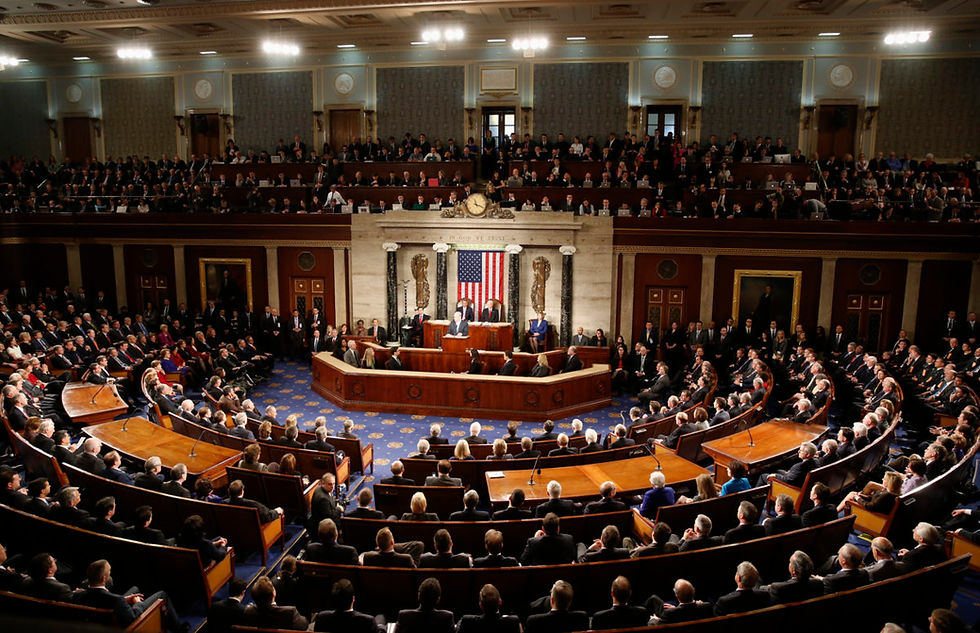
The November 2026 midterms are expected to produce a divided Congress, with Democrats broadly favoured to retake the House while Republicans hold the Senate. If that happens, several legislative priorities that the current majority has been pushing through will face a harder road.
The passage of Section 219 of the 2027 National Defense Authorization Act on July 23 illustrates how contested the US-Israel relationship has become. The provision — proposing joint research, co-production and technology licensing between the two countries — passed the full House by just four votes, 216 to 212, largely along party lines. Senate Democrats blocked debate on the bill the previous week. A Democrat-controlled House after November has the votes to ensure provisions like Section 219 do not survive the next legislative cycle.
Greece hired a Republican-linked lobbying firm at $600,000 a year in February 2025 to maintain its position in Washington after reports that the Trump administration's America First posture raised questions about Alexandroupolis. Souda Bay and Alexandroupolis serve as critical NATO logistics hubs for Eastern Europe, the Middle East and Ukraine resupply. Athens does not take that relationship for granted. A Congress more focused on burden-sharing and less on unconditional alliance commitments changes the environment Greece is navigating heading into its own election.
Israel
Israel's election is scheduled for no later than October 27. Current polling points to deadlock. Netanyahu's coalition projects 50 seats, the opposition 59, Arab parties 11. A governing coalition requires 61. Neither bloc can form a government without either crossing ideological lines that most Jewish party leaders have publicly ruled out or relying on Arab parties, which most of the opposition has also resisted.
Netanyahu is using the remaining weeks before dissolution to push through legislation his coalition partners have demanded for years. Ultra-Orthodox military exemptions, media regulation reform, a weakening of the attorney general's powers. His opponents frame this as institutional entrenchment ahead of a possible loss. His base frames it as governing.
His central political asset — an unmatched relationship with Washington — has taken a measurable hit. The relationship has grown increasingly tense since the start of the Iran war, with Trump openly criticising Netanyahu's Lebanon operations for threatening to derail peace negotiations with Iran. Netanyahu's likely pivot is positioning himself as a leader who stood firm under American pressure. That message has worked before. Whether it works in a race where his main challenger is a former IDF Chief of Staff who lost his son in Gaza is far from certain.
For investors, the October election arrives in a market already absorbing the consequences of prolonged conflict. Israel's FDI inflows fell from a peak of €14.3 billion in 2020 to €4.5 billion in the most recent year. An election deadlock would extend that uncertainty well into 2027, while a result, under either bloc, would at minimum restore policy predictability.
Greece
New Democracy polled at 40% in the last parliamentary election. It is now at 30%. The drop reflects three overlapping pressures: a €392 million EU penalty over agricultural subsidy fraud that forced parliament to lift the immunity of several MPs, the ongoing trial over the 2023 Tempi train disaster in which 57 people died, and an unresolved wiretapping scandal involving surveillance of opposition figures and journalists. None of these individually would threaten a government with a working majority. Together, in a fragmented party system, they have.
Former Prime Minister Alexis Tsipras launched the Hellenic Left Alliance, which has climbed to 17% in recent polls and effectively hollowed out SYRIZA, his former party, now at 2%. A prospective right-wing party from former Prime Minister Antonis Samaras is drawing conservative voters away from New Democracy's traditional base. PASOK holds 11.5%. The parliament that emerges from the next election will be difficult to organise into a stable governing coalition regardless of who comes first.
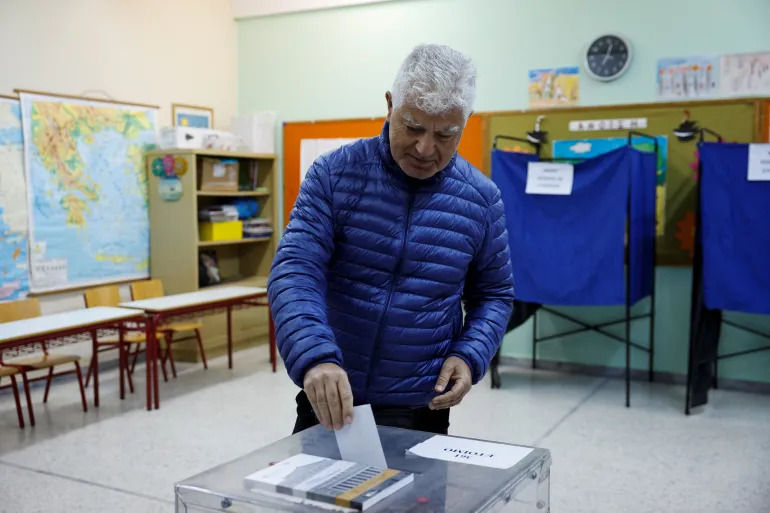
The chances of a snap election are high. The government may move before the constitutional deadline of mid-2027, possibly after the Thessaloniki International Fair in September. The case for going early is to exploit opposition disarray before it consolidates. The case against is that the scandals remain unresolved, GDP growth is forecast to fall from 2.1% in 2025 to 1.6% in 2027, inflation is rising, and the energy price shock is compressing household income.
Member states must complete all NextGenerationEU (NGEU) milestones and targets by August 2026, with final Commission payments running through December. For regions outside Athens, the end of that funding cycle is a cliff. Greece has earmarked its largest NGEU allocation for renewable energy projects, and post-2026 regional investment shifts from direct EU subsidies to private capital and FDI. Just Transition grants of €140 million have been directed at lignite-dependent areas in Western Macedonia and Megalopolis. The National Bank of Greece estimates Greek islands alone will require €35 billion over the next decade for transport, energy and waste management, with public-private partnerships expected to fill the space EU grants occupied.
Greece also enters its election cycle as one of NATO's top five defence spenders, allocating 3.65% of GDP, driven by a €25 billion modernisation programme responding to persistent tensions with Turkey. At the 2026 NATO Summit in Ankara, Mitsotakis emphasised Greece's consistent fulfilment of alliance obligations while warning against any restoration of Turkey to the F-35 programme. A more conditional US Congress gives Turkey room Greece cannot afford.
Outlook
The November 2026 midterms will determine how much flexibility Washington retains in its Eastern Mediterranean commitments over the next two years. A Democrat-controlled House narrows that flexibility on defence cooperation with Israel and NATO burden-sharing with Greece.
Israel heads into October with FDI at €4.5 billion and a coalition arithmetic that points to deadlock. A stable government restores the policy environment investors have been waiting on. Another inconclusive election extends the current uncertainty. Greece, on the other hand, enters its election cycle with EU grant funding ending in August and a financing gap that private capital and public-private partnerships will need to fill regardless of the result.
Investors with established local relationships and longer time horizons are better placed in both markets than those looking for near-term entry points around the electoral cycle.

Comments